Saturday, October 22, 2011

My Prius Turns 100,000 Miles

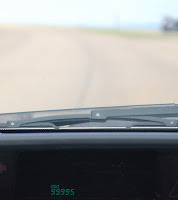
99,995 Miles
Today we celebrated eight years and 100,000 miles together! Me and my Prius. Woo-hoo! I love, love, love my Prius. There is absolutely no doubt about it. Unless there is an even more energy-efficient car by then, my next car will be a Prius too. I love my Prius!
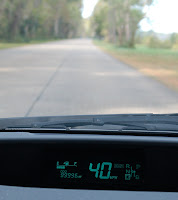
99.996 Miles
And what's not to love about a car that's gotten 50 miles per gallon, plus or minus 5, for 8 years! Now that I'm commuting 57 miles (round trip) 3 days a week, my mileage is averaging about 53 to 57 MPG, probably because the speed limit on the Colonial Parkway third of the trip is 45 miles per hour. (Okay, you noticed the 40 in that last shot. I had to slow down to take this photo. Good thing there wasn't much traffic today!)

99,997 Miles
By commuting to Gloucester, however, my car has reached the 100,000 mile milestone a tad sooner than she might have. Nevertheless, I celebrated and captured the moment in pictures. Fittingly, we were traveling down the Colonial Parkway on the way home to Williamsburg from Gloucester when we hit the mileage milestone.
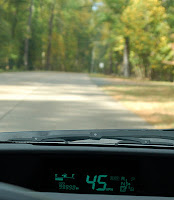
99,998 Miles
In 2003, when my daughter started to drive, Toyota was beginning to promote it's new bullet-shaped 2004 Prius model. The Prius hybrid was a new idea, but the sleek design was a great little lagniappe. As a M.B.A.-Turned-Vegetarian-Environmentalist, the fuel efficiency had me anyway. But as someone who loves great design, I just had to have it. So, I went to my local Toyota dealer and plunked down my $5,000 deposit in August of 2003. I was the second person on their waiting list. My daughter was excited too. I waited for the Prius and she waited for the Prius so that she would get my Honda, which I had thought was the best car on the road until I'd driven the Prius for about a week! My Prius arrived the week of Thanksgiving 2003. I was the second person in Williamsburg to own a Prius.
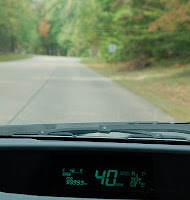
99,999 Miles
Bigger and roomier than my Honda, the Prius had lots of room for groceries, vacation stuff, moving kids in and out of college, and toting stuff back and forth to New Quarter Park. There is even enough room in the Prius to haul my 14.5 ft. kayak, seats down and tailgate secured with bungee cords. I've been to my local dealership faithfully, every 5,000 miles, for scheduled maintenance. I have not had a single problem with my Prius outside of recall notices, which were taken care of during scheduled maintenance trips. All that hoo-ha about brakes and stuff. Bah! Toyota took an undeserved bad-publicity hit on that, in my humble opinion.
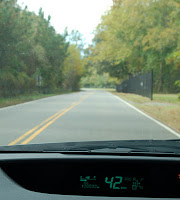
100.000 at the Cheatham Exit!
Here we are at 100,000 miles and just under 8 years later. I don't anticipate trading her in anytime soon, but the Kelley Blue Book trade-in value is $6,550 and the sale value is $8,570. Hmmm. So that means that my Prius has cost me about $2,000 per year. Gas? Let's see ... at an average price of $2.50 per gallon since late 2003 and 50 MPG, I've spent $5,000 or $625 per year. Not bad, I suppose, to pay $2,625 a year for transportation in the good ole US of A these days. Like I said, I love my Prius!

Wednesday, October 19, 2011

Changes and a Brave New Blog

Jamestown Rd. to Rt. 199
Blogging on Williamsburg Wordpecker has slacked off this summer and fall as a career move is taking up more of my time. You may remember that I wrote a blog post a year and a half ago about my change of direction and what prompted me to take it. Since then I've posted random thoughts about this new work I'm pursuing in speech-language pathology.

7:30 a.m. on the Colonial Parkway
To bring you up to date, I've been accepted to a graduate program offered by James Madison University. What fun! Really! I love the course information and my colleagues. The work is sometimes a pain in the butt, but I don't get too stressed. Thank heavens for my love of education and maturity. I know that life's a journey and I'm probably over the hump, enjoying the downhill ride. To me, the courses and the work in speech-language pathology are so much more exhilarating and fulfilling than the options: more engaging than early retirement and far less stressful than business!

8:00 a.m. - Crossing the York River
So far, I've enjoyed the people I've met as a volunteer at CDR and substitute speech teacher in Williamsburg-James City County schools while taking undergrad prerequisite courses. I am now in my second semester of grad school and have already found employment in this high-need field. A small elementary school in Gloucester was having trouble filling a speech position and offered me a part-time, provisional teaching position. Granted, there probably aren't too many young people who want a part-time teaching position in a rural community, but it's just about perfect for me. Part-time is all I want and my aging parents live in Gloucester.

5:30 p.m. - Coming home
So here I am. On the road again. Three days a week I hang a right on Jamestown Road and head to the Colonial Parkway and Gloucester. These days, instead of random thoughts about my yard, I'll probably be posting more often to my other blog. It's one I maintain through the school to communicate with parents about speech and language development.

Fortunately, about half of my 56-mile round-trip commute takes me along the Colonial Parkway where that part of me that yearns to be on the waterfront is satisfied. This October, the peaceful views are tinged red-orange. For now my photos are fuzzy and through the car window, but I may be stopping from time to time in the future to capture a more perfect shot.

Tuesday, September 13, 2011

Good Night Irene

Irene visits my neighborhood
Since I got environmental religion about 10 years ago, I've watched in disbelief as the deniers denied and as most other people didn't think too much about it. Our recent post-Hurricane Irene week without electricity made me start thinking about the climate again. I watched an interesting NOVA show, "Secrets Beneath the Ice." It was a good refresher with new information on advances in the science behind global warming.

I just read an article in Nature with some news about tying climate and weather together in a more accurate manner. That will be useful. Here's an excerpt:

Heavy weather

Severe storms make the public think of climate change. Scientists must work to evaluate the link.

Extreme weather makes news, as was demonstrated last month by the blanket coverage of the devastation caused to the east coast of the United States by Hurricane Irene. But was the prominence of the story a feature of modern media hype in a rolling-news world? Hardly. According to a New York Times analysis, when Hurricane Andrew made landfall in Florida in 1992 and killed 22 people, it received twice the traditional news coverage that Irene did.

What is new is that coverage of extreme weather is now often accompanied by a question: is this a consequence of climate change? This question was raised frequently after Hurricane Katrina smashed through New Orleans in 2005. Most climate scientists responded equivocally, as scientists do: climate is not weather, and although all extreme weather events are now subject to human influence, global warming driven by greenhouse gases cannot be said to 'cause' any specific manifestation of weather in a simple deterministic sense.

Is that response enough? The question, after all, seems fair, given the dire warnings of worsening weather that are offered to the public as reasons to care about global warming. It may irritate some scientists, but in fact the question can be seen as a vindication of their efforts to spread the message that the climate problem is a clear and present danger. Most people associate the climate with the weather that they experience, even if they aren't supposed to. And they are right to wonder how and why that experience can, on occasion, leave their homes in pieces.

Given the growing interest, it is a good sign that scientists plan to launch a coordinated effort to quickly and routinely assess the extent to which extreme weather events should be attributed to climate change (see page 148). The ambitious idea is in the early stages, and its feasibility is yet to be demonstrated. It will require funding, access to climate data from around the world and considerable computer time. Funding agencies and climate centres must provide the necessary support.  [More]


Nature 477, 131–13, (08 September 2011), doi:10.1038/477131b. Published online 07 September 2011.

I look forward to reading more about progress on the ability to attribute storms to climate change. 

Saturday, August 13, 2011

Holly with red bark?

Red-blotched Holly
On a recent trip to Nags Head, we took a walk along the Sweet Gum Trail at Nags Head Woods Preserve, a Nature Conservancy property on the North Carolina Outer Banks. It was a jewel of a find on that overcrowded barrier island, which always leaves this environmentalist a little sick in the stomach and depressed. Too many beach houses and tourists crowded on a narrow sand dune. Too much water use and waste. But that's a discussion I've had with myself too many times. Back to the trail.

Lichens thrive in harsh environments
We found the maritime forest to be just as advertised, quite biologically diverse. I was particularly intrigued by the holly tree with red-blotched bark. What was that tree? It looked like your typical  Ilex opaca (American holly), but could it be something else? The red stuff was on holly trees everywhere, making the mixed forest look somewhat eerie, as if the forest home of the Sir Walter Raleigh's claim were harboring natives in war paint, quietly waiting for the moment to turn the tables on modern invaders who came in SUVs. 

I asked my naturalist friends about the unusual trees at today's bird walk, but no one knew of a holly with red blotches on its bark. Finally, I made it home to do a little Googling. Seems that this wonderful red rash is a growth of that ethereal composite life form called lichen, which is mostly fungus and requires a cooperative arrangement with algae and cyanobacteria in order to survive.

Lichenization is a survival strategy for fungus and it is often found in harsh environments, like the sandy Outer Banks with soil low in nutrition.  Most lichens are gray or green, but the red color of this variety is due to light exposure and dry climate. For more about lichens, check out the book Lichens of North America.

Saturday, July 9, 2011

fMRI connects city living with mental health

This is you brain on city living


I'm studying neuroimaging this week in my neurology course so clicked on a link that struck me in my Nature.com news feed. The authors of City living and urban upbringing affect neural social stress processing in humans conducted a study that showed functional magnetic resonance images (fMRI) to prove that stress affects the brains of city folk differently. This sort of stress leads to physical and mental health disorders. In their words: "Our results identify distinct neural mechanisms for an established environmental risk factor, link the urban environment for the first time to social stress processing, suggest that brain regions differ in vulnerability to this risk factor across the lifespan, and indicate that experimental interrogation of epidemiological associations is a promising strategy in social neuroscience."

Areas of the brain that are involved here include the perigenual anterior cingulate cortex (pACC) and the amygdala. The pACC region is involved in experiencing emotions and regulating behavioral as well as reacting to psychosocial stress. It may be the neuroanatomical structure that perceives social standing and thereby contributes to our mental and physical health. The amygdala is a part of the limbic system, which has been called the brain's emotional center. The amygdala is famously associated with fear and anxiety. It is connected to pathways responsible for defensive behaviors and it is the part of the brain that is responsible for emotional processing. In the city, these areas are always on alert. There, people are continually subject to the Shakespearean "slings and arrows" from bossy people and bad bosses. Saber-tooth tigers (cars, alarms, airplanes, and other such menacing noises) jump at them from every direction.

While the authors don't point to the flip side -- the physical and mental health benefits of one's proximity to a natural environment -- I'll do it here. Richard Louv might agree. As one who has personally benefited from re-establishing a healthy relationship with nature, I think I am physically and mentally better for it. I feel some sort of calming sense in my brain and body every time I get lost in examining the details of nature or get my hands, fingernails, and nostrils full of rich, fragrant soil. I would be in the portion of the study group that grew up in a rural environment and now lives in an urban area (population over 100,000). The study group that grew up and currently lived in an urban environment was of greater interest to the authors of the Nature article.

The authors conclude, "Our data reveal neural effects of urban upbringing and habitation on social stress processing in humans. These findings contribute to our understanding of urban environmental risk for mental disorders and health in general. Further, they point to a new empirical approach for integrating social sciences, neurosciences and public policy to respond to the major health challenge of urbanization." Ah, the far-reaching implications of brain research empowered by new neuroimaging technology.