Showing posts with label environmentalism. Show all posts

Saturday, October 22, 2011

My Prius Turns 100,000 Miles

99,995 Miles
Today we celebrated eight years and 100,000 miles together! Me and my Prius. Woo-hoo! I love, love, love my Prius. There is absolutely no doubt about it. Unless there is an even more energy-efficient car by then, my next car will be a Prius too. I love my Prius!
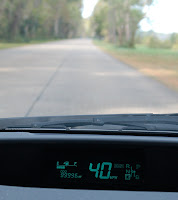
99.996 Miles
And what's not to love about a car that's gotten 50 miles per gallon, plus or minus 5, for 8 years! Now that I'm commuting 57 miles (round trip) 3 days a week, my mileage is averaging about 53 to 57 MPG, probably because the speed limit on the Colonial Parkway third of the trip is 45 miles per hour. (Okay, you noticed the 40 in that last shot. I had to slow down to take this photo. Good thing there wasn't much traffic today!)

99,997 Miles
By commuting to Gloucester, however, my car has reached the 100,000 mile milestone a tad sooner than she might have. Nevertheless, I celebrated and captured the moment in pictures. Fittingly, we were traveling down the Colonial Parkway on the way home to Williamsburg from Gloucester when we hit the mileage milestone.
99,998 Miles
In 2003, when my daughter started to drive, Toyota was beginning to promote it's new bullet-shaped 2004 Prius model. The Prius hybrid was a new idea, but the sleek design was a great little lagniappe. As a M.B.A.-Turned-Vegetarian-Environmentalist, the fuel efficiency had me anyway. But as someone who loves great design, I just had to have it. So, I went to my local Toyota dealer and plunked down my $5,000 deposit in August of 2003. I was the second person on their waiting list. My daughter was excited too. I waited for the Prius and she waited for the Prius so that she would get my Honda, which I had thought was the best car on the road until I'd driven the Prius for about a week! My Prius arrived the week of Thanksgiving 2003. I was the second person in Williamsburg to own a Prius.
99,999 Miles
Bigger and roomier than my Honda, the Prius had lots of room for groceries, vacation stuff, moving kids in and out of college, and toting stuff back and forth to New Quarter Park. There is even enough room in the Prius to haul my 14.5 ft. kayak, seats down and tailgate secured with bungee cords. I've been to my local dealership faithfully, every 5,000 miles, for scheduled maintenance. I have not had a single problem with my Prius outside of recall notices, which were taken care of during scheduled maintenance trips. All that hoo-ha about brakes and stuff. Bah! Toyota took an undeserved bad-publicity hit on that, in my humble opinion.
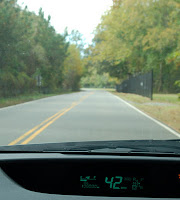
100.000 at the Cheatham Exit!
Here we are at 100,000 miles and just under 8 years later. I don't anticipate trading her in anytime soon, but the Kelley Blue Book trade-in value is $6,550 and the sale value is $8,570. Hmmm. So that means that my Prius has cost me about $2,000 per year. Gas? Let's see ... at an average price of $2.50 per gallon since late 2003 and 50 MPG, I've spent $5,000 or $625 per year. Not bad, I suppose, to pay $2,625 a year for transportation in the good ole US of A these days. Like I said, I love my Prius!

Tuesday, September 13, 2011

Good Night Irene

Irene visits my neighborhood
Since I got environmental religion about 10 years ago, I've watched in disbelief as the deniers denied and as most other people didn't think too much about it. Our recent post-Hurricane Irene week without electricity made me start thinking about the climate again. I watched an interesting NOVA show, "Secrets Beneath the Ice." It was a good refresher with new information on advances in the science behind global warming.

I just read an article in Nature with some news about tying climate and weather together in a more accurate manner. That will be useful. Here's an excerpt:

Heavy weather

Severe storms make the public think of climate change. Scientists must work to evaluate the link.

Extreme weather makes news, as was demonstrated last month by the blanket coverage of the devastation caused to the east coast of the United States by Hurricane Irene. But was the prominence of the story a feature of modern media hype in a rolling-news world? Hardly. According to a New York Times analysis, when Hurricane Andrew made landfall in Florida in 1992 and killed 22 people, it received twice the traditional news coverage that Irene did.

What is new is that coverage of extreme weather is now often accompanied by a question: is this a consequence of climate change? This question was raised frequently after Hurricane Katrina smashed through New Orleans in 2005. Most climate scientists responded equivocally, as scientists do: climate is not weather, and although all extreme weather events are now subject to human influence, global warming driven by greenhouse gases cannot be said to 'cause' any specific manifestation of weather in a simple deterministic sense.

Is that response enough? The question, after all, seems fair, given the dire warnings of worsening weather that are offered to the public as reasons to care about global warming. It may irritate some scientists, but in fact the question can be seen as a vindication of their efforts to spread the message that the climate problem is a clear and present danger. Most people associate the climate with the weather that they experience, even if they aren't supposed to. And they are right to wonder how and why that experience can, on occasion, leave their homes in pieces.

Given the growing interest, it is a good sign that scientists plan to launch a coordinated effort to quickly and routinely assess the extent to which extreme weather events should be attributed to climate change (see page 148). The ambitious idea is in the early stages, and its feasibility is yet to be demonstrated. It will require funding, access to climate data from around the world and considerable computer time. Funding agencies and climate centres must provide the necessary support.  [More]


Nature 477, 131–13, (08 September 2011), doi:10.1038/477131b. Published online 07 September 2011.

I look forward to reading more about progress on the ability to attribute storms to climate change.