Tuesday, August 17, 2010

It's Time to Bid Farewell to Our Queen's Creek Oyspreys

I've been leading a program at New Quarter Park called BYOK (Bring Your Own Kayak) for the last 5 years. One of my regular pleasures is watching the Ospreys arrive and build their nests out of branches perched precariously on channel markers and platforms. On our 2 1/2 hour paddle up Queen's Creek and back, we pass a half-dozen nests and see more at a distance. Kayakers enjoy watching the big birds raise their young, dive for fish, screech, and soar majestically. We float as close as they'll allow and snap photos of families as they grow through the season. All of this happens between March/April and August/September. Alas, about this time of year they migrate.

This Saturday I'll be leading BYOK and talking to participants about the Ospreys and their habits once again. I'll tell them that if they come to BYOK next month, the birds will be gone, off to "darkest Peru," to quote Paddington Bear.

Well, not exactly Peru. Although they might go there, our East Coast birds probably migrate to someplace along the East Coast of South America. I received my copy of BirdScope in the mail today and was interested to learn about an initiative to fit Ospreys with solar-powered satellite transmitters and monitor their route to learn more about migratory patterns and assess potential threats to the migrating birds. BirdScope is not online (it's a benefit of membership!), so I can't link you to it. But I've copied a bit of it here for your information.

Backpacking Ospreys: Peering over the shoulders of migrating Ospreys

by Alan Poole 
 
On a clear morning in early September 2008, a three-month-old female Osprey named Penelope pushed off from Martha's Vineyard, Massachusetts, and flew, alone, 2,700 miles to French Guiana in 13 days. 

She touched down in coastal Maryland and North Carolina for three days, lazed along the Bahamas for four, then blew through the Dominican Republic in 29 hours. At dusk she launched out over the Caribbean, flying all night and the next day to a tiny island off the coast of Venezuela. A week later she was exploring rainforest rivers in French Guiana, her home for the next 18 months.

Twenty years ago we couldn't imagine the extraordinary trips that these fish-eating raptors -- our summer neighbors on their big stick nest -- take routinely . . .  Now researchers can strap a 0.75-ounce, solar-powered satellite transmitter onto the back of an Osprey and know the bird's location, within a few hundred yards, for the next two to three years. 

. . . With the help of Google Earth, we can see ecological details about the places Ospreys winter by visiting http://bit.ly/ospreytrack . . . [This project] is providing much-needed data revealing migrational differences among Ospreys and helping pin down where threats to Ospreys lie.

(Alan Poole is the author of Ospreys: A Natural and Unnatural History (1989, Cambridge University Press).)

Wouldn't it be fun to suit-up one of the Queen's Creek Ospreys with a backpack and watch online as he or she travels?

Ah well, join me on Saturday to see our birds off: Until next year, dear feathered friends!

Note: The summer issue of BirdScope also includes a story from the Biodiversity Institute in Gorham, Maine, about birds and tracking mercury pollution. Friends of New Quarter Park and readers of this blog may be interested to know that this is where our "Bluebird Girl" Allyson Jackson is headed this month for employment. Another farewell! Be safe and prosper!

Sunday, August 15, 2010

Witness to Alternative Energy

On our trip to Chicago last week we took the "southern route" which, for us, goes across Virginia and West Virginia on I-64, turns north on I-77, takes an off-Interstate jag through Ohio to I-70, and then turns north at Indianapolis on I-65. By the time we were an hour north of Indianapolis, I felt like we were almost there, so I put down my knitting and started to pay attention to the scenery.

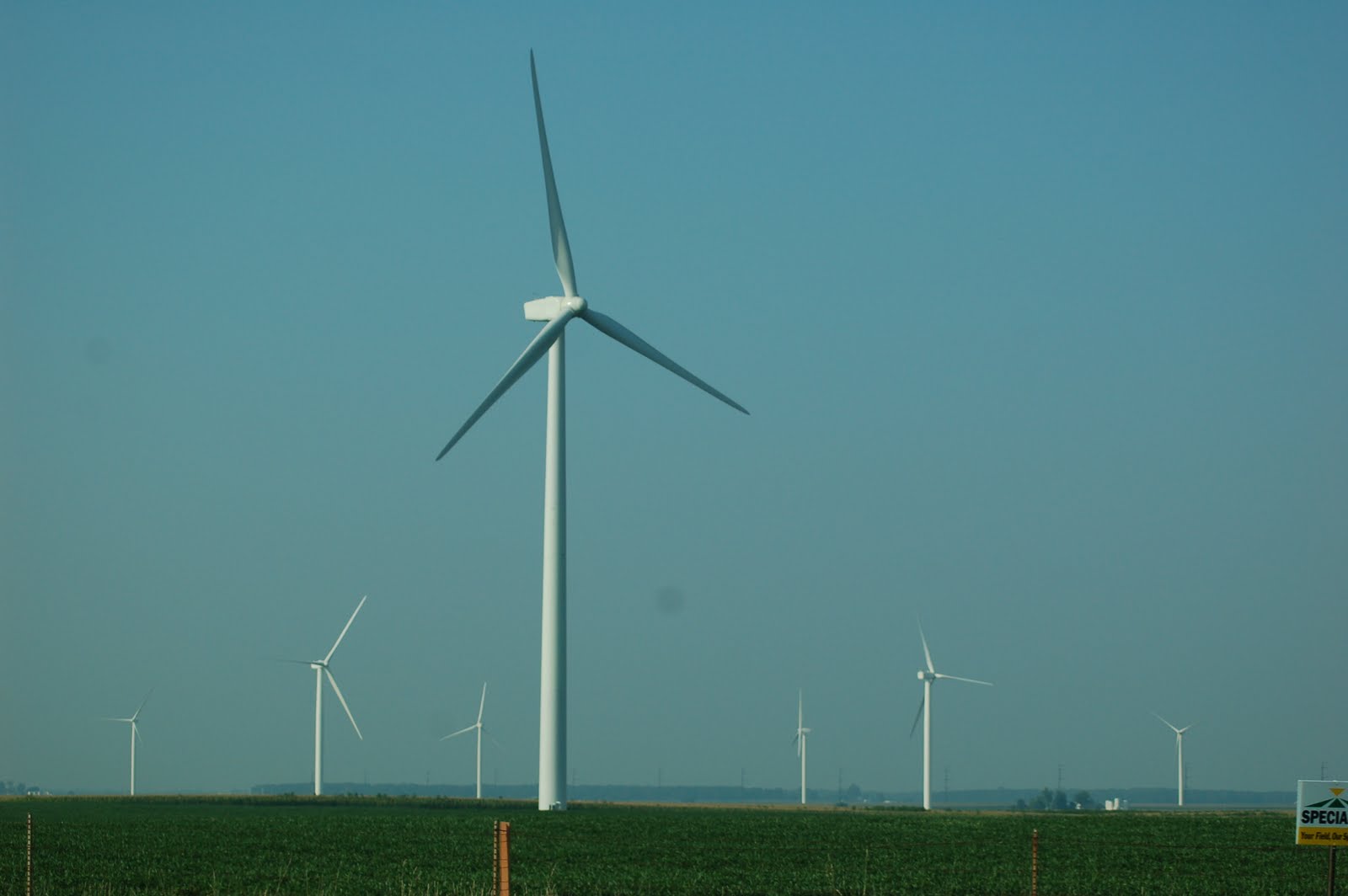
Just north of Lafayette, Indiana, I was excited to see windmills spreading in every direction across the flat landscape of corn fields. I hadn't seen anything like this since I was in California more than 10 years ago. Wow. I pulled out my camera and started snapping at 70 mph. I'm glad that a few of the photos caught good views that I can share with you. 

Back home now, I am excited to learn that this is the Fowler Ridge Wind Farm, a partnership between BP Wind Energy and Dominion --- yes, that BP . . . and my power company! Dominion owns half of the Indiana wind farm as well as an entire wind farm in Illinois, another partnership with Shell in West Virginia, and is exploring wind projects in the western part of Virginia.

This was good news following a rather glum piece I heard this morning on CBS Sunday Morning about our feeble attempts as a country to get serious about alternative energy. After clips of Obama, Bush, Clinton, and even Nixon promoting wind and alternative power, the reporter said:

"But for all the talk about the energy of tomorrow, America is still powered by the energy of yesterday. Ninety-five percent of our electricity comes from an aging network of coal (47%), natural gas (21%), nuclear (20%), and hydroelectric plants (7%).

Despite decades of promises, less than five percent of our electricity currently comes from all other forms of alternative energy, combined."


Energy is something that's been hard for me to wrap my brain around. As a "smaller portions" environmentalist (see The Middle Path: Avoiding Environmental Catastrophe) I have saved water by installing low-flow toilets and we've swapped out our washer, dishwasher, and water heater for Energy Star varieties. I hang clothes outdoors to dry. I'm a vegetarian. I drive a Prius. I recycle and compost. I am careful about consumption choices. I do the things I can to cut back, but really now, how can I do anything about where the electricity comes from? I can't install a windmill in my backyard. I suppose I could put a solar panel on the roof, but it's not easy enough for me, the average homeowner, to understand, afford, and embrace.

So it's nice to know that my energy company is making a pretty big investment in wind. This tells me that its time to stop feeling helpless and make the effort to learn more. Thanks, Dominion.  

Again, from CBS Sunday Morning:

"The United States is the world leader in wind energy, and while it's still relatively expensive to produce, with new technology, costs are coming down.

"'We're just tapping into the very beginnings of potential with wind,' says
[Patrick] Woodson [who is in charge of development for E.ON Energy in the West Texas town of Roscoe, where oil rigs once dotted the landscape] . . ."

Woodson was talking about the biggest wind farm in the world. But even so, it only powers up 7 percent of the energy needs of Texas.

He says that to get us focused on alternative energy, "We need a national policy... to really give us some direction on where we're gonna go."

I witnessed tomorrow's energy in the winds rolling across the Indiana plains. I'm psyched. I'm ready to push for a national policy and get behind leadership that makes alternative energy take off.

Friday, August 13, 2010

Visiting Charlotte

This is Charlotte at 12 days old. Isn't she adorable? Grandpa and I visited baby Charlotte and her parents earlier this week.

We've visited son Thomas in Chicago in the past. He's lived there for 4 or 5 years now while working on his Ph.D. at the University of Chicago. On this visit we stayed close to home, visiting in their Hyde Park apartment and taking turns holding our little one. On Wednesday, we took two outings to the city.

Unfortunately, I have to admit that I do not care for Chicago. I've never been easy-going about the hustle-bustle of city life, but it's more than that. The natural landscape of the area bothers me. It's flat. The downtown cityscape is pretty, but I prefer green to glass and steel. Lake Michigan doesn't smell like the brackish Chesapeake Bay. Between downtown and Hyde Park: urban blight. There are a lot of empty lots, decrepit buildings and unkempt weediness. All over the city the confusion of imported plant material from far east and west, sitting side by side, gives me a sense of disease that has to do with the lack of an appropriate, life-sustaining ecosystem and habitat continuity. I can't breathe.

What birds and butterflies can call the created natural infrastructure of Chicago home? The Monk Parakeets have famously done so. This August the tropical birds found an abundance of red berries in the trees near Washington Park and along the streets of Hyde Park. They squawked and carried on in flocks that I imagine Charlotte will be able to admire from her third floor nursery window soon.

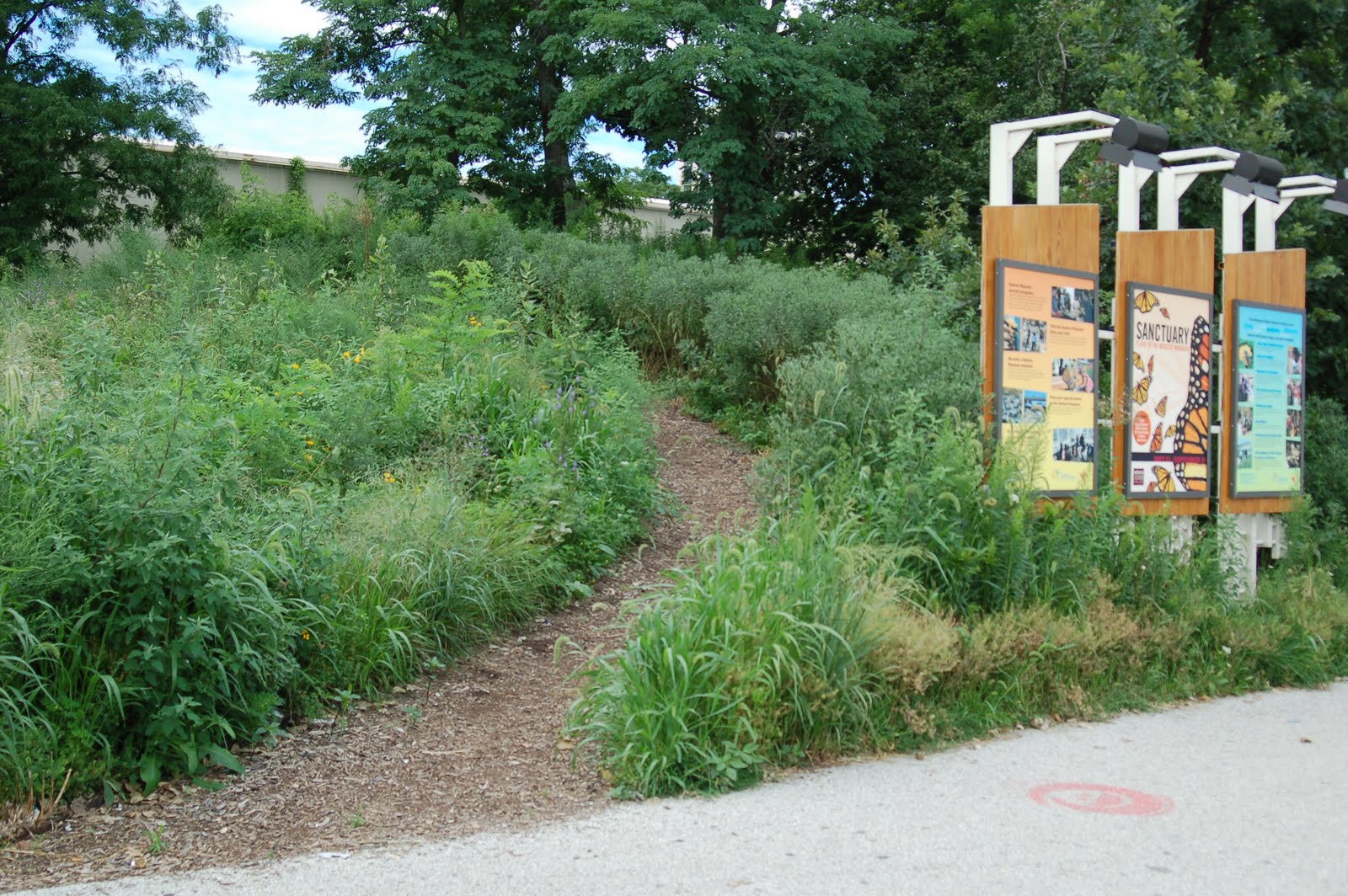
But on this visit to Chicago, I'm happy to report that I saw something that made me feel a little better about Chicago. I saw that an attempt was being made to bring native prairie grass and pollinators like Black-eyed Susans and Cone Flower back into park spaces and median plantings. I was glad to see that. We stopped at the Nature Museum, where Thomas goes to dump off his recyclables, and I briefly read about the restoration of wild areas along the Lake in Northeast Illinois between Wisconsin and Indiana.

An alliance of groups began preserving wild lands there in 1996. They have managed to gather up 7% of the area land in a reserve called Chicago Wilderness. They assessed threats and made recommendations in a report card on the health of the area's wild lands. Their four initiatives include developing nature to lessen the impact of climate change, encouraging green infrastructure, helping children connect with nature, and improving the health of ecosystems.

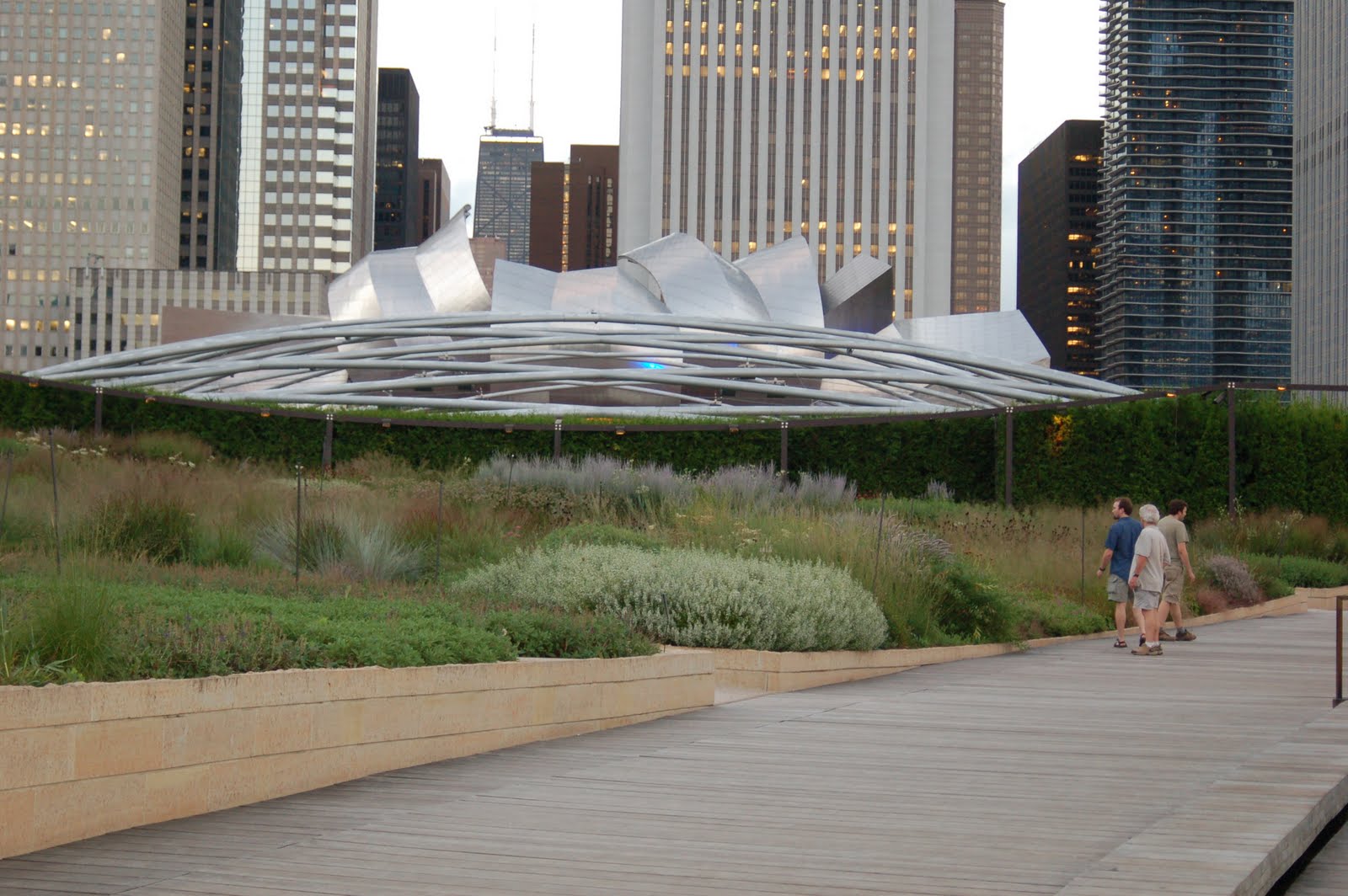
I was glad that the many areas of wildflowers and grass that were blooming during our early August stay piqued my interest and helped me appreciate the ecosystem restoration work. On Wednesday evening at Millennium Park, I was excited to see a created "wilderness" park surrounding and softening all of that machine-like glass and steel in downtown Chicago.

Once an area where prairie met and interacted with woodlands, humans have drastically altered the Chicago landscape. Charlotte's generation will be challenged to bring the life-giving and sustaining quality of nature back into places like Chicago as they take charge.

Before I go to Chicago again I will read Miracle Under the Oaks: The Revival of Nature in America, to learn about the revival of the ecosystem around the crazy backwards-flowing Chicago River. I want to take the river cruise that Thomas suggested (A View from the River: The Chicago Architecture Foundation River Cruise). I'll read Carl Smith's book about Daniel Burnham’s 1909 Plan of Chicago to better understand how the Chicago Wilderness organization is "building on that legacy to bring nature to people and make this region an even more exceptional place to live and work."

When Charlotte is a little older we'll visit Chicago again, perhaps. I hope she will want us to take her inside the Nature Museum when we drop off the recyclables. By then I will take with me a new understanding and curiosity for the place. I hope that I will be able to share an enthusiasm for natural systems with Charlotte in Chicago, a place where "nature is accessible to all residents, and the built environment reflects  [the Chicago Wilderness organization's] commitment."

Friday, August 6, 2010

How to Identify Poison Ivy

If you know me or have been reading my blog for awhile, you know that I haven't always been such a nut about nature, birds, and gardening. In fact, it was only about five or six years ago that I started to get outside again, after twenty years in an office. It was during my first year as an outdoors woman that I learned about that evil invasive English Ivy and the evil itch of Poison Ivy.

Since I live in an older neighborhood just 3 miles from Colonial Williamsburg, colonial-type architecture, big hardwood trees, and tradition plantings dominate. English Ivy has run amok. Without the homes and lawns, my natural community would be a mesic mixed hardwood forest, which seems to reappear in the second-growth strips between houses in older subdivisions like mine. Sometimes I wonder if the root stock in my yard was brought by the colonists, perhaps Mark Catesby himself. Actually, that's not such a far out thought because English Ivy is a native European plant that was introduce to North America during colonial times. It was a traditional (you know, as in "The Holly and The Ivy") ground cover that grows fast in sun or shade and is drought tolerant. And it out-competes other plants. In my yard, several English Ivy vines as big around as my arm have out-competed several small trees, may they rest in peace.

So, when I decided to care about my yard, job one was to set to work pulling Ivy. It's the only way to get rid of it, so I've been told. There are some versions of Roundup for woody vines, but I didn't want to kill the native American Euonymus or any American Holly or Flowering Dogwood saplings, or any other native inhabitants of my mixed hardwood forest. One August weekend, I spent a whole weekend pulling Ivy into a huge pile for the garbage man and then we went on vacation. And I started itching. Poison Ivy. Miserable vacation. Miserable homecoming. Miserable month until the stuff was gone. I can still see scars where I popped a couple of the blisters. That's a no-no.

These days I can definitely identify Poison Ivy. There are several sing-song-sayings to help you too, such as "leaves of three, let it be," "berries of white, run in fright," and "hairy rope, don't be a dope." (See the photo here of a vine at New Quarter. Yipes!) One time I was out with a Boy Scout Den at New Quarter Park and I was warning the boys about poison ivy. One of them said that the leaves look like a mitten. Great observation.

Poison Ivy is native to Virginia. It has waxy leaves with a serrated edge (think steak knife edge) that grow in groups of three leaflets.The two outside leaflets look like mittens. The center leaflet looks like a two-thumb mitten! In the summer, small green fruits slowly grow round, ripe, and white. The berries are noxious for people too, but birds love to eat them in autumn.

Since my yard is a wildlife habitat, I don't pull every piece I see. When it's in an out-of-the-way place, I leave it alone. When I do decide to pull a bit of it to keep it in check, I put my arms in those long plastic bags that the newspaper comes in to pull up the vines. I carefully pick up the ivy that I've pulled and pull the bag off my arm, inside out, so that in the end it contains the ivy, which I put in the garbage.

The element in Poison Ivy called urushiol is what causes an allergic reaction in humans. The skin becomes itchy, red, and blistered. It is not pretty. Urushiol is on the leaves and the vines and roots, so it's not safe to touch any of the plant. Don't mow it or burn it either, because the urushiol becomes airborne and can be inhaled. That can be life-threatening.

The Urban Jungle column in last Sunday's Washington Post mentioned a lot of this same information and also included a sidebar about global warming and Poison Ivy. Here's what they had to say:

Global warming, poison ivy swarming

Poison ivy responds robustly to increasing CO2 levels, stepping up leaf and stem production -- even increasing its concentration of urushiol.

Scientists grew identical sets of poison ivy plants in atmospheres with various concentrations of carbon dioxide, based on levels from the mid-20th century, the present day and a projected future. Two-inch rhizome segments were sprouted and cultivated for 250 days before leaves were harvested and measured. 


I've noticed that we had an awful lot more poison ivy at the park last year, but like everything else, the heat may have stunted it's growth this year. In any case: Poison Ivy: It's One More Thing To Worry About! Geez, Louise.

Tuesday, August 3, 2010

Nurturing Wildlife Habitat at New Quarter Park


USDA Private Lands Biologist Tiffany Beachy (left) and VDGIF Watchable Wildlife Biologist Steve Living (center) came to New Quarter Park today to assess our Bobwhite habitat. They are seen here with Joanne Chapman (right) from York County. The crew talked about how to get rid of the fescue that's invading the field and stunting the growth of the good plants we planted last year to feed and shelter Northern Bobwhite. It looks like Roundup will be involved.

To get rid of the grass, we're going to mow and rake the meadow, then wait until the grass is about 6 inches tall and really sucking down the nutrients, and finally knock it out with Roundup. We hope that most of the plants like Black-eyed Susans and Partridge Pea as well as many other grasses and perennials will be dormant so that the herbicide will just kill the grasses. The Bobwhite Habitat Restoration is a partnership between York County, the Virginia Native Plant Society, the Virginia Master Naturalists, and the Williamsburg Bird Club.

We also took a look at the Teaching Garden with Jeanne Millin of the Historic Rivers Chapter of Virginia Master Naturalists to discuss what's next there. The plan is to shore up the path and rain garden, then plant in the fall to create a showplace for the native species that thrive in the park. We're also setting aside an area to develop as a butterfly garden to attract pollinators and encourage more butterflies to come out to the park. The box turtles already love the place!

We hope that people will get the idea that biodiverse, natural landscapes sustain us. Plant wildflowers, not grass ... and read this book: